

How to Play Snakes and Ladders: Rules, Gameplay and Tips
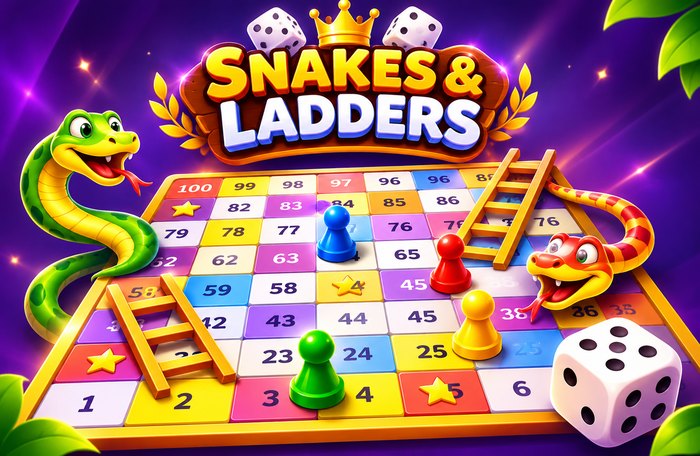
Snakes and Ladders is a traditional board game played with numbered squares, player tokens and a dice. The objective is to move from the starting position to the final square by rolling the dice and following the numbered path.
The board contains ladders that move tokens forward and snakes that send them backwards. A player can climb a ladder after landing on its starting square, while landing on a snake’s head takes the token down to its tail.
The game is easy to understand and suitable for children, families and casual players. This guide explains how to play Snakes and Ladders, how the board works, the basic rules and the common variations.
What Is Snakes and Ladders?
Snakes and Ladders is a board game traditionally played by two or more players. A common version uses a board with 100 numbered squares arranged in a grid.
Each player selects a token and places it at the starting position. Players then take turns rolling a six-sided dice. The number shown determines how many squares the token moves forward.
The board contains ladders connecting lower-numbered squares to higher-numbered squares. It also contains snakes connecting higher-numbered squares to lower-numbered squares.
These special squares change a player’s position and make each turn unpredictable. The first player to reach the final square completes the game.
What Do You Need to Play?
A standard Snakes and Ladders game includes:
- Game board: Usually contains 100 numbered squares.
- Dice: A six-sided dice determines movement.
- Player tokens: Each player uses a token to mark their position.
- Players: The traditional game supports two or more players.
In digital versions, the board, dice and tokens appear on the screen. Players use the available controls to roll the dice and move their tokens.
Understanding the Snakes and Ladders Board
The board is divided into rows of numbered squares. The numbers usually follow a zigzag pattern, moving from one row to the next.
Two special elements appear across the board:
Ladders
Ladders connect a lower square to a higher square. The bottom of the ladder marks the position where a player must land to climb it.
For example, if a ladder starts at square 12 and ends at square 35, a player who lands on square 12 moves directly to square 35.
Snakes
Snakes connect a higher square to a lower square. The head marks the square where a player must land to slide down.
For example, if a snake’s head is on square 48 and its tail ends at square 19, a player landing on square 48 moves back to square 19.
The number and placement of snakes and ladders depend on the board design.
How to Play Snakes and Ladders: Step-by-Step Guide
Step 1: Set Up the Board
Place the board on a flat surface where all players can see the numbered squares.
Each player selects a token and places it at the starting position. The starting position may be just before square one or on the first square, depending on the version.
Decide the order of play. Players can agree on an order or use a dice roll to determine who starts.
Step 2: Roll the Dice
The first player rolls the dice. The number displayed determines how many squares the token moves forward.
For example:
- A roll of one moves the token one square.
- A roll of three moves the token three squares.
- A roll of six moves the token six squares.
After completing the move, the next player takes a turn unless the version has an additional-turn rule.
Step 3: Follow the Numbered Path
Move the token along the numbered squares in the direction shown on the board.
A standard 100-square board uses a zigzag layout. At the end of each row, movement continues along the next row in the opposite direction.
Count each square carefully to ensure that the token reaches the correct position.
Step 4: Climb a Ladder
Check the square where your token lands.
If it is the bottom of a ladder, move the token to the square at the top.
For example, landing on square 16 may take you directly to square 42 if those squares are connected by a ladder.
The ladder movement is completed immediately. The next player then takes their turn.
Step 5: Slide Down a Snake
If your token lands on a square containing a snake’s head, move it down to the square where the snake’s tail ends.
For example, landing on square 74 may take you back to square 51 if a snake connects those positions.
The backward movement is part of the game’s rules. Once the token reaches the lower square, the turn is complete.
Step 6: Continue Playing
Players take turns rolling the dice and moving their tokens.
Each move can change the position of a player. A ladder can move a token several squares ahead, while a snake can send it back to an earlier part of the board.
Continue following the numbered path until a player reaches the final square.
Step 7: Reach the Final Square
The final square is usually numbered 100.
Many standard versions require an exact dice roll to reach this square. For example, a token on square 96 needs a four to reach square 100.
If a player rolls a number that would take the token beyond the final square, the move may not be allowed. This rule depends on the version being played.
The first player to reach the final square completes the game.
Basic Rules of Snakes and Ladders
The common rules are:
- Each player selects one token.
- All tokens begin at the designated starting position.
- Players take turns rolling the dice.
- Tokens move forward according to the number rolled.
- Landing at the bottom of a ladder moves a token to the top.
- Landing on a snake’s head moves a token down to its tail.
- Players follow the numbered path across the board.
- The first player to reach the final square completes the game.
- Some versions require an exact dice roll for the final square.
- Additional-turn rules may vary between versions.
Check the instructions supplied with the board or digital game before starting.
Snakes and Ladders Tips
1. Understand the Numbering Pattern
Learn the direction in which the numbers move across the board. This prevents mistakes when moving between rows.
2. Identify the Ladders
Notice where ladders begin and where they end. This helps you understand how your position can change after a move.
3. Look for Snake Positions
Check where the snake heads are located. This helps you identify the squares that can send your token backwards.
4. Count Every Move Carefully
Move one square at a time and follow the numbered sequence. Incorrect counting can place a token on the wrong square.
5. Understand the Special Rules
Some versions allow an additional turn after rolling a six. Others use different rules for entering the board or reaching the final square.
6. Keep Track of Your Position
After every move, check the square occupied by your token. This makes it easier to identify ladder and snake movements.
Common Mistakes to Avoid
- Moving the token in the wrong direction.
- Forgetting to climb a ladder.
- Missing a snake after landing on its head.
- Counting the movement incorrectly.
- Assuming every board follows the same additional-turn rule.
- Moving beyond the final square when an exact roll is required.
Frequently Asked Questions
1. How many squares are there in Snakes and Ladders?
A common version has 100 numbered squares. Other versions may use different board layouts.
2. How many players can play?
The game can be played by two or more players, depending on the version.
3. What happens when you land on a ladder?
Your token moves from the bottom of the ladder to the square at its top.
4. What happens when you land on a snake?
Your token moves from the snake’s head to the square where its tail ends.
5. Do you need an exact number to reach square 100?
Many standard versions require an exact dice roll to reach the final square.
6. Does rolling a six give another turn?
This depends on the version. Some boards allow another turn after a six, while others use different rules.
7. Can Snakes and Ladders be played digitally?
Yes. Digital versions display the board, dice and player tokens on the screen.
Conclusion
Snakes and Ladders uses a simple set of rules. Players roll a dice, move their tokens along numbered squares, climb ladders and slide down snakes.
Understanding the board layout, movement sequence and special squares is enough to get started. The exact rules for additional turns and reaching the final square may vary, so check the instructions for your version before playing